





As AI tools enter litigation workflows, the question is no longer ‘if’ AI tools can assist litigation lawyers, but more ‘when’ those tools will be integrated into practices. The question for firms has become which of the available tools best complements the realities of litigation practice.
The AI tool that is best for litigation lawyers will reflect two central realities of litigation practice - that it is an information-dense and risk-sensitive practice.
One emerging capability of Habeas points clearly towards the future of AI tools in litigation: secure and matter-specific document intelligence.
Most AI tools today operate by querying large datasets, often scraped from public sources, before producing an answer. Indeed, Habeas itself is trained on a body of publicly available Australian legal sources, from which it searches relevant case law and legislation and accordingly generates answers to legal queries. This approach has a particular use in legal research, for broad queries where research has not yet been conducted or for analytical purposes.
However, for the relevant and case-specific queries that often crop up in litigation work, lawyers sometimes do not want to consider broad datasets, but instead want to work within the realm of the specific case materials. This is what ‘matter-specific document intelligence’ is: the capacity for an AI tool to understand and reason over the documents that make up a matter.
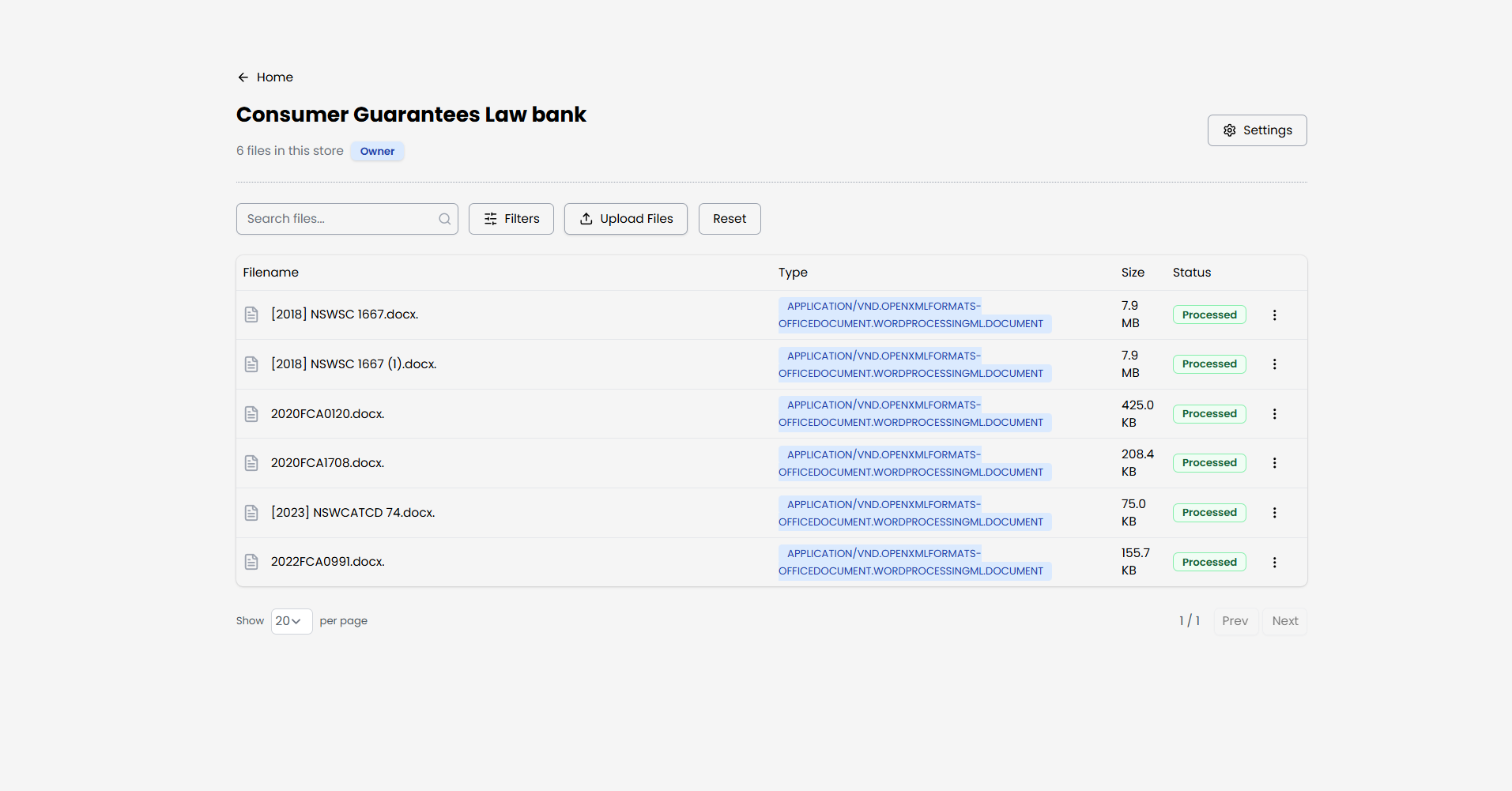
The future of AI litigation tools addresses this through the creation of secure document stores for individual matters, to which legal reasoning tools can be exclusively applied. Habeas’ document store feature (currently in beta) does just that.
A document store allows lawyers to upload and organise matter-specific materials, such as:
· Pleadings and amended pleadings; and
· Affidavits and witness statements; and
· Any evidence documents; and
· Expert reports; and
· Correspondence and internal memoranda.
Lawyers might also want to use the store as a way to upload very specific materials they've accumulated over a period of time, such as relevant case law or authorities to the practice area they work in. But most are looking to use Habeas as a way to 'speak to their case' fluidly.
Once the store is created, users can filter the search engine to only consider the document store as the data from which the answer is generated, or they can use the Habeas assistants feature to reason over and search only a particular set of documents, rather than mixing their answer with public datasets which might be irrelevant to the particular query.
Crucially, this does not change the nature of the legal reasoning tools themselves. The same document-processing, extraction, and reasoning capabilities that apply to public law datasets can instead be applied to a controlled and private body of material.
The difference is contextual precision: litigation workflows can be assisted by the precise application of the technical research tool to their specific case materials.
Security in this context is often discussed narrowly as a question of where documents are stored. Importantly, in litigation, security also concerns how documents are processed.
That is, future-ready AI tools must ensure the following:
· Secure uploaded documents are not used to train models; and
· Analysis is confined to the defined document set; and
· Outputs remain traceable to the material provided; and
· Nothing is leaked across matters or users (however, there is role-based access control for users who want to share document sets with others in the firm).
These features allow lawyers to interrogate their own case materials using AI-assisted reasoning and processing, without compromising confidentiality or professional obligations.
When AI tools can reason exclusively over a matter-specific document store, they become genuinely useful for particular litigation tasks. These include: identifying inconsistencies across evidentiary sets, tracing the evolution of arguments across pleadings, summarising large evidentiary records, and preparing for cross-examination or opposing submissions.
Instead of replacing professional judgment, this context-specific tool augments it, reducing friction in analysis and freeing litigation lawyers up to focus on strategy rather than document triage.
The future of AI litigation tools is not necessarily bigger models or broader datasets. Bigger is not always better. Instead, the future is narrower, more controlled intelligence, applied with precision to the materials that actually matter.
Litigation practice demands tools that respect boundaries, including jurisdictional boundaries, evidentiary boundaries, but most relevantly professional boundaries. Systems that allow lawyers to build secure document stores and apply sophisticated reasoning tools within those confines are not just safer, but also are more structurally aligned with how litigation work actually occurs.
