





When we started Habeas, the pitch was straightforward: better legal research for Australian lawyers, built from the ground up for Australian law and the nuances of Australian legal workflows. That’s still true.
But we’re always receiving feedback and observing how lawyers want to use Habeas, and of course, research is rarely the end point. It’s often the beginning of a document, an advice letter, a memo, a brief. The gap between finding the answer and producing the work product with references and key information integrated is where a lot of time disappears.
Already, Habeas was being adopted in 2026 for a whole range of use cases (issue-spotting, triage, complex research, search and legal analysis, and document drafting). But this month’s update introduces more intuitive workflows that just make sense for lawyers looking to use Habeas as their base legal OS for a variety of complex analytical workflows.
Below is a summary of what we shipped, based on customer feedback and requests over the last few months.
The problem
Most firms have precedents scattered across shared drives, personal folders, and the memories of senior practitioners. When it comes time to draft, you’re starting from a blank page or hunting for a template that may or may not be current.
Further, with a lot of AI tools, there’s a weird process of not quite getting a document in the style or format you need. Oftentimes, it’s not deeply context-informed in the way you need. Or maybe the tool spits out something you have to reformat, or with strange citation formatting.
What we built to solve it
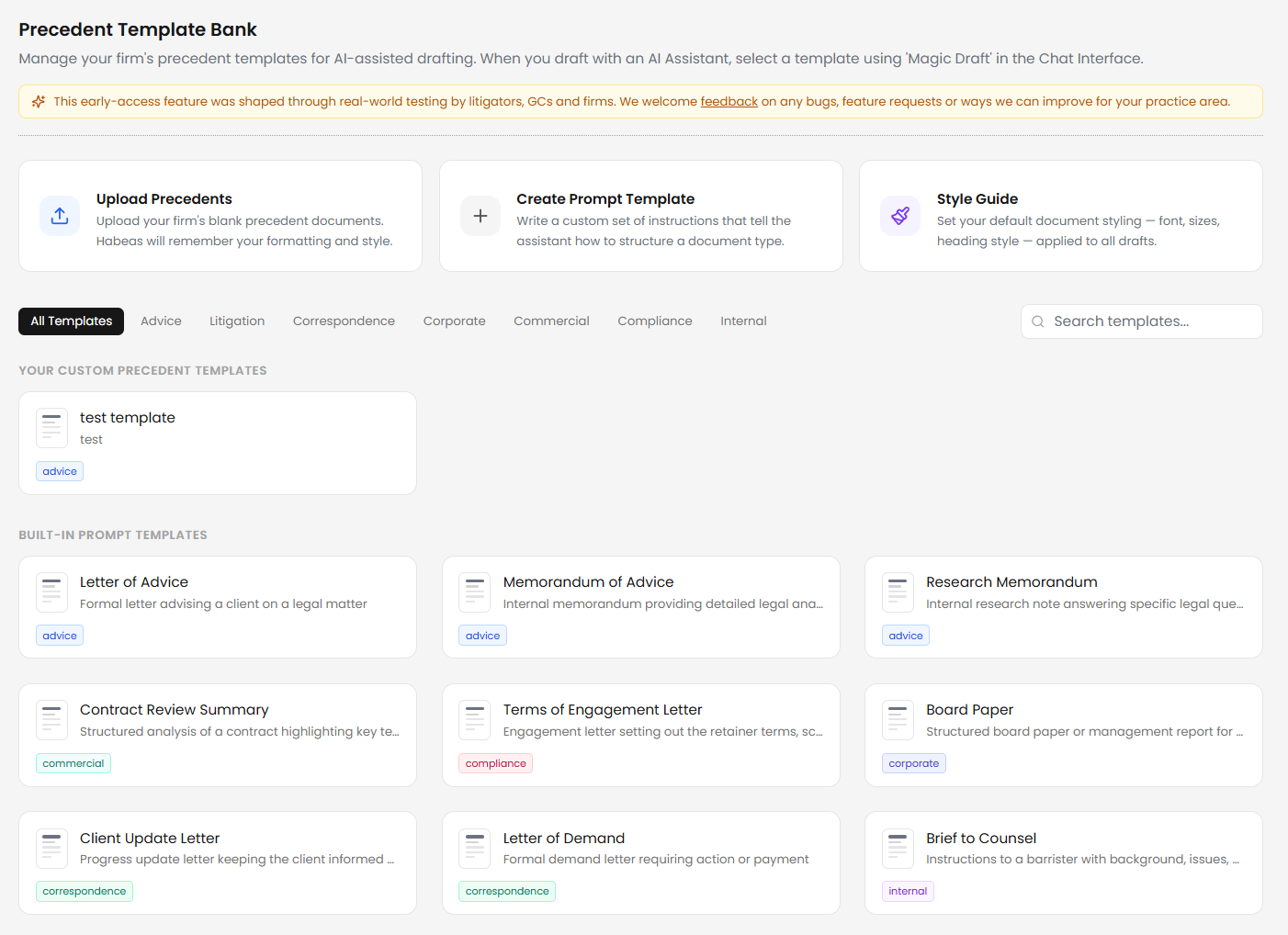
The new Precedent Bank lets you upload your firm’s precedent documents (DOCX) or create prompt-based draft templates directly in Habeas.
When you’re chatting with any AI assistant, Magic Draft lets you select a template and generate a fully structured document, formatted to match your chosen template or precedent, exportable as a clean DOCX with one click.
If you say to Habeas “draft me a research memo on X”, it will also auto-recommend templates in-chat.
We’ve included 15+ built-in templates spanning advice, litigation, corporate, commercial, and general practice to get you started. You can also create your own, either by uploading a precedent which Habeas will retain the style and formatting of, or by writing a prompt-based template from scratch.
This is a complex feature and is therefore in early access. Drafting is high-stakes for our customers, and we’d rather iterate with real feedback than assume we’ve nailed it. As you try it and incorporate it into your workflows, let us know what works and what needs improvement.
Lawyers think in narrative. They think in language. They explain fact patterns out loud to colleagues, dictate notes after client calls, and talk through issues before they write. This has always been core to the design process of Habeas for legal search.
We’ve now added a microphone button to the chat bar so you can dictate instructions and questions directly to the assistant. The goal is for dictation to understand, as much as possible, the needs of Australian lawyers in terms of spelling, capitalisation, segmentation of questions, and tone.
It’s a small feature, but it was repeatedly requested, and we’ve found it changes how people interact with the platform, particularly for complex fact patterns or setting up assistant templates and prompts, where typing can feel like a bottleneck.
Document Stores were one of our most requested features when we launched them. The concept was sound: upload your own documents and let the AI search and reason across them. But the interface made it harder than it should have been to get started.
We’ve rebuilt the experience from scratch. The interface is cleaner, onboarding is simpler, and there’s a new “Chat with these docs” button that drops you straight into a conversation with a collection pre-loaded.
Document stores now appear directly in the Sources menu in chat, so you can select exactly which collections the assistant searches alongside Australian case law and legislation. Before, it was unclear to some users about when documents were selected as a source, and which collections were selected.
By default, document stores are switched off. This is intentional. When enabled, they help ensure your research is always matter-informed and allow for detailed analysis of specific files and authorities you upload to give Habeas richer context.
Quick Chat and default assistants now run on updated models, delivering more reliable research, better-structured analysis, and stronger drafting.
That said, the core advantage of Habeas remains the base layer of Australian legal knowledge and our search systems, which ground outputs in real data and legal commentary.
We were also aware that assistants often didn’t know when they were being asked to perform tasks they couldn’t complete. The assistant now clearly flags when a question goes beyond its search capabilities and suggests where to go next.
If a full judgment text isn’t available, Habeas will point you to the source citation and suggest downloading the document. If an answer requires documents it doesn’t have access to, it will say so and prompt you to upload them.
We believe this matters more than raw intelligence. A research tool that oversells its confidence is worse than one that clearly communicates its limits.
We’ve tightened the quality of AI-drafted documents across the board.
Drafts now:
For advisory documents such as letters of advice, research memoranda, and internal memos, drafts now use proper prose with section headings rather than numbering every paragraph.
Magic Draft is designed to be flexible. For example, you can create your own prompt-based template that conforms to the style guide of a particular court or practice area. So if you are writing submissions for the HCA, you can make sure you're conforming with expected practice.
There were also a range of quality-of-life improvements:
None of these are headline features, but they reflect something we care about. The platform should feel considered and intuitive, and every interaction should suggest that someone has thought about whether it works well.
We’re continuing to invest in ensuring Habeas is best-in-class for research-informed legal intelligence for lawyers looking to get a real edge in complex matters and disputes.
Precedent Bank is in early access beta for a reason, and we expect it to evolve significantly based on how firms use it. Over the coming months, we’re also deepening our coverage of Australian legal sources and improving how the assistant handles multi-step and jurisdiction-specific research tasks,
If you have feedback, ideas, or specific precedent workflows you’d like to see supported, reach out at habeas.ai/contact. We read everything.
