





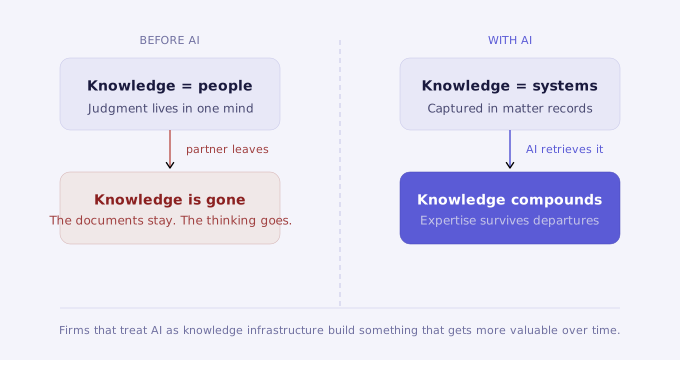
Knowledge assets are often embodied, rather than documented. For instance, a senior partner who has run construction disputes for twenty years carries a mental map that exists nowhere else in the firm: containing elements like which expert witnesses perform well under cross-examination, and which arguments have succeeded before specific judges.
When that practitioner leaves, retires, or moves to another firm, the knowledge leaves with them. Although the matter files remain and the documents are retrievable, the judgment built across years of similar matters does not survive the departure. Every law firm of any age has experienced this problem, yet very few have solved it.
The knowledge management industry has been trying to address this problem for decades. Knowledge portals, precedent libraries, matter databases, post-matter debrief processes, experience management systems: the tools are not new. The problem is that capturing structured institutional knowledge requires effort from the practitioners who have it, at precisely the moment they are least likely to have spare capacity or inclination.
For example, a senior partner who just concluded a complex commercial dispute is not, at the point of conclusion, inclined to complete a structured knowledge capture document. The incentives do not align: the cost of capture falls on the individual, and the benefit accrues to the firm over a timeframe too long to feel immediate. Systems that depend on consistent voluntary contribution from busy practitioners produce inconsistent, sparse data.
AI does not solve the capture problem directly. A system that retrieves knowledge cannot retrieve knowledge that was never recorded. What AI changes, significantly, is the retrieval problem for whatever knowledge does exist in the firm’s systems.
A practitioner who can query a firm’s matter history in natural language, asking not just for documents containing specific keywords but for matters involving similar fact patterns, comparable regulatory issues, or analogous contractual disputes, extracts substantially more value from the firm’s existing matter database than a practitioner limited to keyword search. Institutional knowledge that is technically accessible but practically unreachable becomes usable.
The corollary is that firms investing in knowledge capture now, through structured matter debriefs and richer precedent data, will extract substantially more value from AI retrieval than firms whose records remain sparse. The quality of what AI can surface is a function of the quality of what has been captured.
Boutique and mid-tier firms that compete against larger practices typically do so on the basis of deep expertise in specific practice areas. That expertise is almost entirely embodied knowledge, held in the heads of a small number of senior practitioners. When those practitioners leave, the competitive differentiation diminishes.
Firms that treat AI as a knowledge infrastructure investment, not only as a research efficiency tool, build institutional capability that is less dependent on individual retention. The strategic advantage compounds over time in a way that pure efficiency gains do not... the firm’s accumulated expertise becomes accessible across the practice rather than sitting with a handful of individuals.
