





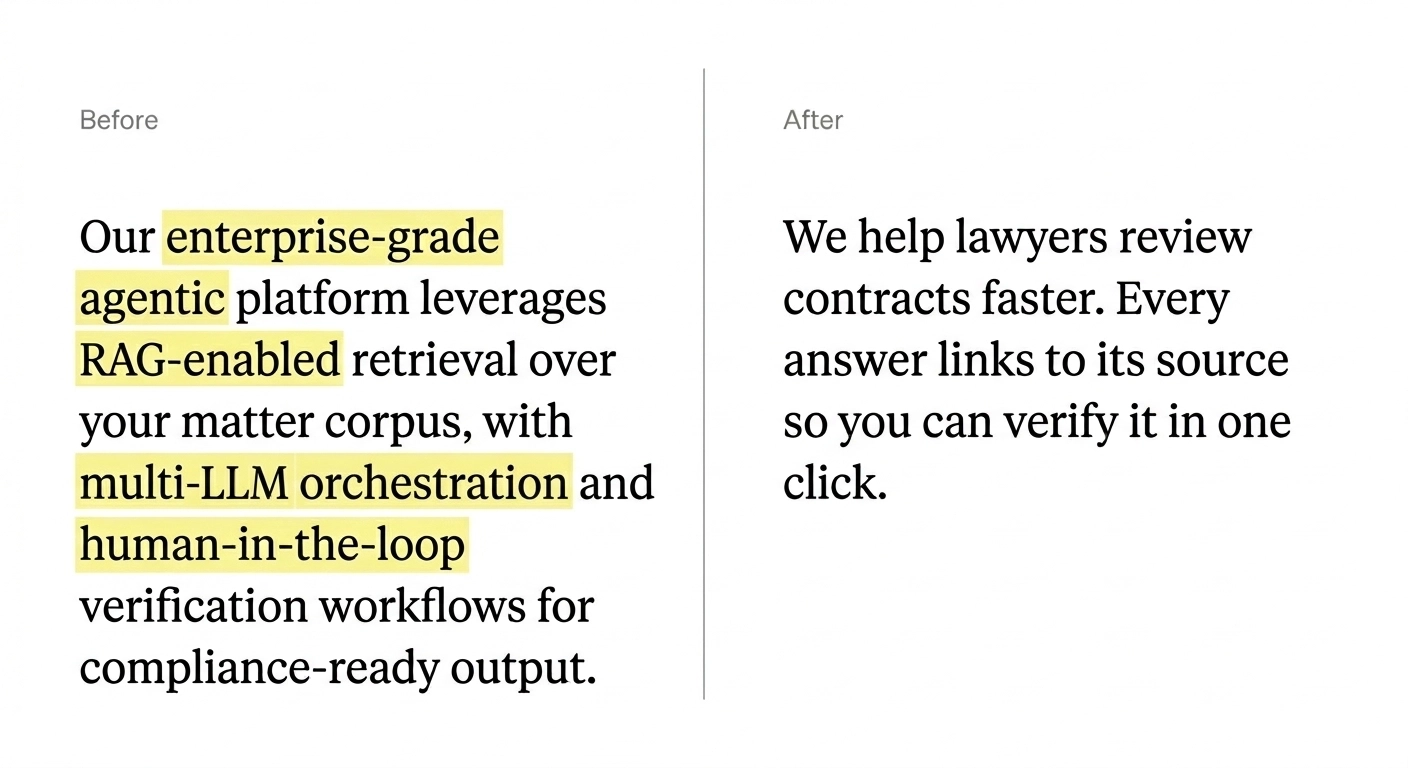
There is a particular kind of sentence that has started appearing on legal AI product pages, and it goes something like this: 'Our enterprise-grade agentic platform leverages RAG-enabled retrieval over your matter corpus, with multi-modal LLM orchestration and human-in-the-loop verification workflows for compliance-ready output.'
It is a sentence designed to sound impressive, but despite that perceived impressiveness also tells a working lawyer almost nothing about whether the product would help them.
The phenomenon is widespread enough to deserve a name, so we call it the acronym problem. Legal AI marketing has, over the past two years, developed a dialect of three-letter abbreviations and technical jargon that has more in common with a Hacker News comment thread than with the way lawyers actually talk about their work. RAG, LLM, MCP, TAR, agentic, multi-modal, enterprise-grade, human-in-the-loop.
The acronyms are doing two jobs at once, and both are problems.
The first job is signalling technical sophistication to investors. Venture capital is the audience that rewards a product page heavy with current-cycle terminology, because acronym density reads as proximity to the frontier. This is fine when the audience is a VC.
The second ‘job’ is obscuring the underlying claim from those buyers. A general counsel reading 'agentic workflow with multi-modal retrieval' is being asked to evaluate a product on terms that require either capitulating to the vendor's vocabulary or doing forty minutes of background reading before the next meeting.
This matters more in legal than in other categories, because lawyers are professionally trained to be suspicious of language they cannot pin down. The moment a sales pitch leans on undefined jargon is the moment the procurement instinct kicks in. A product page reading like a research paper signals that the company has not yet figured out how to talk about itself to the people who would pay for it.
There is also a deeper issue. The legal profession is being asked to adopt a category of technology whose risks include hallucination, privilege exposure, and professional negligence claims that have not yet been tested in court. The buyer's primary task is to understand what the tool does and how it could fail. A vendor whose marketing makes the first part harder is, at best, indifferent to the second.
The test is straightforward. If a product description cannot be read by a senior associate without a glossary, the description is not doing its job. If a vendor cannot explain in one paragraph what their tool does, what it replaces, and where it could go wrong, that is a clarity problem, and clarity problems in legal AI marketing tend to track clarity problems in legal AI products.
Habeas has made a different choice. The product is described in the words a lawyer would use, the failure modes are named in the words a lawyer would understand, and the claims are written so that a buyer can verify them on a live matter before signing anything.
If you are evaluating legal AI right now, it’s worth asking every vendor to describe what their product does in one paragraph, without using an acronym they have not defined in the previous sentence. The answers will tell you a lot.
